
People often use the word “realistic” for an AI companion when it feels personal rather than generic. That feeling rarely comes from one feature. It comes from small things adding up across many conversations. Here are seven qualities to look for, what each one really involves, and how Duple approaches it. All Duple details come from its App Store listing and Privacy Policy.
1. Memory and continuity
Nothing breaks the feeling faster than having to repeat yourself. A companion that remembers your sister’s name, the job interview you mentioned, or the fact that you hate mornings feels like it’s been paying attention. In software, memory usually means the app saves selected details and brings them back into later replies when they seem relevant.
That is useful, but it’s never perfect. A good app tells you what it saves and lets you change it. Be wary of any promise of flawless recall.
How Duple handles it: Duple’s Privacy Policy says your chat messages are processed to pull out facts, emotional moments and preferences, which are stored as companion memories. When you chat, relevant memories are retrieved so your companion feels “contextually aware and consistent over time.” You can reset or delete these memories at any time. For more detail, read how AI companion memory works.
2. Personality consistency
Real people have a recognisable voice. They’re playful or dry, gentle or blunt, and they stay that way from one day to the next. A companion that is warm on Monday and generic on Tuesday feels like a different character. Consistency comes from a defined character, with a background, interests and style, that the app uses every time it replies.
How Duple handles it: In Duple you choose your companion’s background, appearance and style when you create them. The Privacy Policy lists the name, appearance, personality, interests and other attributes of the companion you create as data Duple stores to remember who your companion is. The App Store listing says you can shape the experience around your preferences over time. You aren’t limited to one, either: Duple lets you create a roster of companions, each with their own look and personality, and swipe between them on the home screen.
3. Natural conversation
Natural conversation is less about long, polished paragraphs and more about rhythm. That means answering what you actually said, asking a follow-up, and handling small talk as easily as a serious topic. It also means the companion can talk about the world, not only about itself.
How Duple handles it: Duple’s listing describes natural conversation by text: sharing everyday thoughts and exploring ideas. You can also send photos in chat. The Privacy Policy says they may be analysed to create a short visual description for your companion. When your companion runs a web search during a conversation, the query is processed by an AI provider so the reply can draw on current information.
4. Images and visual identity
For many people, a companion feels more real once it has a face that stays the same. A consistent look, the same person in every picture, helps turn a chat window into a character. Images that respond to the conversation add to that.
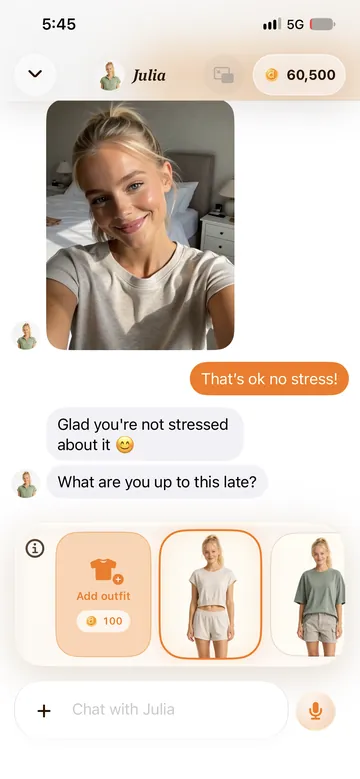
How Duple handles it: Visuals are central to Duple. Its listing describes receiving generated selfies, creating personalised pictures, designing custom outfits and building a wardrobe, and keeping saved images in one personal library. The Privacy Policy mentions avatar identity assets and profile crops, which the app stores so your companion’s generated media stays tied to that companion. Every Duple companion and generated image is fictional.
5. Emotional responsiveness
A companion feels present when it notices tone, such as celebrating good news or slowing down when you’re having a hard day, instead of answering every message the same way. This is generated behaviour, not feeling, but it shapes how a conversation lands.
How Duple handles it: Duple’s Privacy Policy says “emotional moments” from your conversations are among the things saved as companion memories, alongside facts and preferences, so later replies can take them into account. Duple is clear that it doesn’t provide medical, mental-health, financial, legal or other professional advice. If you’re struggling, please reach out to someone you trust or a professional service.
6. Boundaries and honesty that it’s AI
It may sound backwards, but honesty makes a companion more believable over time. An app that claims its character is a real person, or that it has human feelings, sets up a let-down. Clear labelling, sensible age settings and moderation make the experience something you can trust. Read more in are AI companions real?
How Duple handles it: Duple’s listing says every companion and generated image is fictional, and that the app is designed for entertainment, creativity and AI-powered conversation. The visible US App Store lists Duple as 16+ on November 3, 2026; its Privacy Policy requires users to be 17 or older. The Privacy Policy describes automated moderation that scans inputs and outputs for policy violations, and says your age is used to set the adult age options shown when you create a companion.
7. Privacy you control
Intimate conversation needs trust. Before you share personal details, check what an app stores, who processes it, and how to delete it. The more a companion remembers, the more this matters.
How Duple handles it: Duple’s Privacy Policy says it does not sell your personal data and does not continuously track your location. Payments go through the App Store, so Duple doesn’t collect card details. You can reset or delete specific data in the app, and you can delete your account in Settings. The policy also names the AI providers that process chat and image requests. Read the full Privacy Policy before deciding what to share.
What realism can’t promise
Even the most convincing companion can misunderstand you, forget something, or get facts wrong. A companion may sound caring, but it doesn’t have human emotions or consciousness. Enjoy it as conversation and creativity. It isn’t a substitute for professional care or the people in your life.
Comparing apps on realism
Different apps put different qualities first. Some focus on voice calls, some on long-term memory, some on large character libraries, and Duple on a companion’s visual identity. Our AI companion app comparison sets out memory, images, voice, pricing and age ratings for six iPhone apps side by side, using their official listings. To check costs, see how much AI companion apps cost.
FAQ
What is the most realistic AI companion?
The one that feels most consistent to you: it remembers what you share, keeps a stable personality and look, responds naturally, and is honest that it’s AI. Different apps focus on different parts of that, so compare them against what matters most to you.
Does Duple remember past conversations?
Yes. Duple has long-term memory, so your companion remembers you across conversations. Its Privacy Policy says facts, emotional moments and preferences from your chats are saved as companion memories and brought back when relevant. You can reset or delete these memories at any time. Like any AI memory, it isn’t perfect recall.
Can an AI companion have real feelings?
No. A companion can generate replies that sound caring or reflect your mood, but it doesn’t have human emotions or consciousness. Duple describes its companions and generated images as fictional.
Can I see what my Duple companion looks like?
Yes. Duple’s App Store listing describes generated selfies, personalised pictures, custom outfits and a personal library for saved images.
Is it private to talk to an AI companion?
It depends on the app. Duple’s Privacy Policy says it doesn’t sell your personal data, lets you reset or delete specific data, and lets you delete your account in Settings. Always read an app’s privacy policy before sharing sensitive details.
More: Duple memory and Live Selfies.
Create a companion that’s yours
Design their look, chat by text, and make pictures together on iPhone.
Get Duple on the App StoreSources
- Duple: Pics & Chat, US App Store: features, 16+ rating (visible US App Store, November 3, 2026) and the fictional-content statement; checked October 13, 2026.
- Duple Privacy Policy: companion memory, moderation, data controls and AI providers.
Duple publishes this guide. It is general information, not medical, legal or professional advice.